
The 18 Best Marketing Automation Platforms for Startups


At first, you may not think you need a marketing automation tool. A spreadsheet, a few email templates, and some manual follow-up can get the job done, until growth makes that system harder to manage.
More leads turn into more follow-ups, more customer journeys, and more opportunities for something to slip through the cracks. Marketing automation helps take that repetitive work off your team’s plate while keeping lead nurturing and customer communication consistent.
But the goal isn’t to automate everything. It’s to find the right platform for the way your startup actually works.
In this guide, we’ll break down what marketing automation is, the features that matter, and the platforms worth considering as you grow.
What Is Marketing Automation?
Marketing automation is technology that handles repetitive marketing, sales, and customer lifecycle tasks automatically.
In simple terms, you create a rule that says: when this happens, do this next.
Imagine someone submits a demo request. Without automation, a marketer might need to check the form, create a CRM record, assign the lead, send a confirmation email, alert the sales team, and remember to follow up. With automation, these steps occur in the background while your team focuses on moving opportunities down the pipeline.
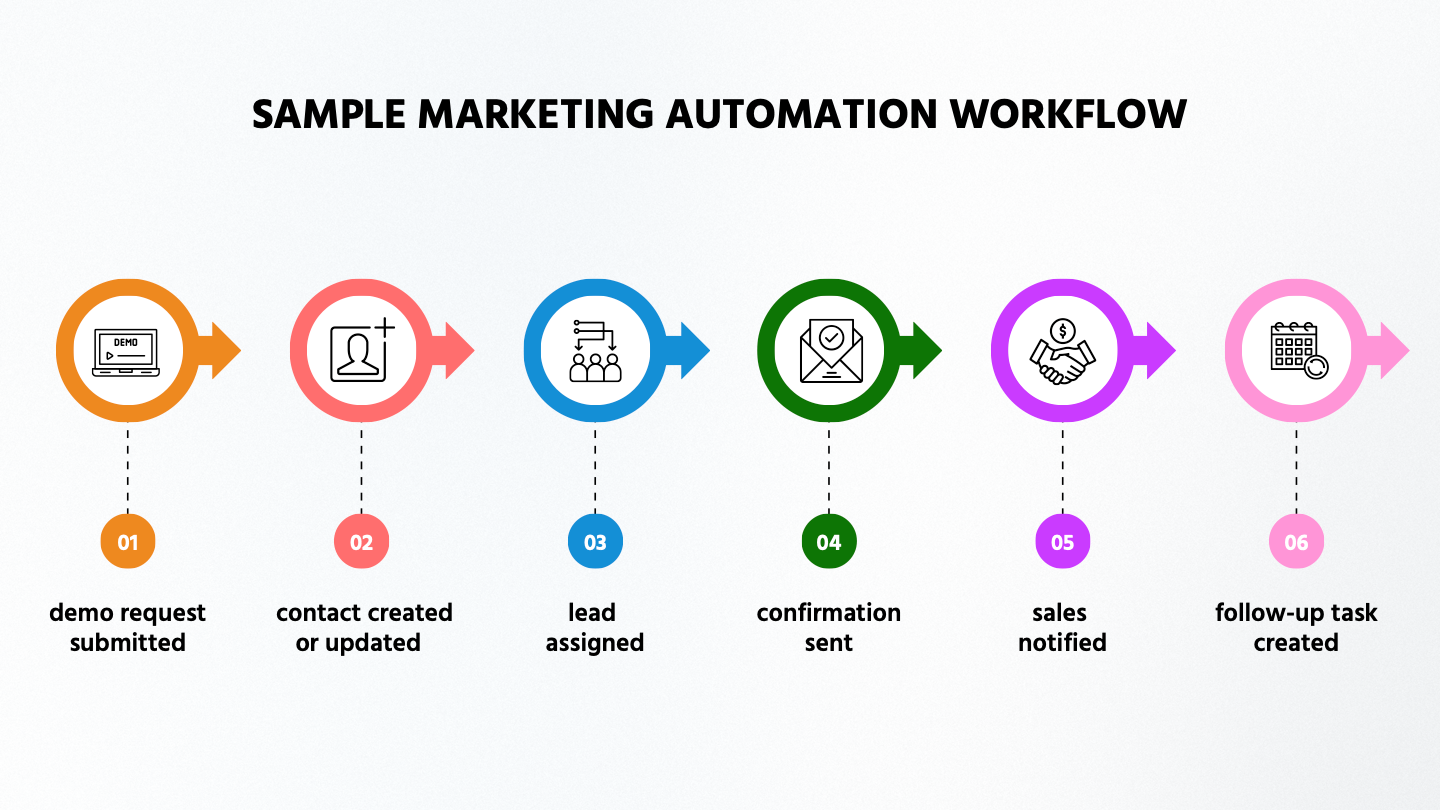
That same idea can be applied across the customer journey. HubSpot, for example, supports CRM-powered workflows for email follow-up, lead scoring, forms, customer journeys, notifications, and other routine marketing activities.
Common tasks startups automate include:
- Welcome email series
- Lead nurturing
- Webinar follow-up
- Contact segmentation
- Lead scoring
- CRM updates
- Meeting scheduling
- Internal notifications
- Demo-request routing
- Customer onboarding
- Re-engagement campaigns
- Lead assignment
- Lifecycle stage updates
- Data synchronization between platforms
The clearest sign you need automation is actually a good one: your strategy is working, and your manual processes can’t keep up anymore.
What Are The Marketing Automation Benefits for Startups?
Save Time
Automation takes repetitive work like follow-ups, CRM updates, lead routing, and campaign tasks off your team’s plate. Gartner expects AI-driven automation to grow from 16% of marketing work in 2026 to 36% by 2028, showing just how quickly automated workflows are becoming part of everyday marketing operations.
Create Consistent Customer Experiences
Automation helps make sure prospects receive timely follow-up, onboarding, reminders, and other communication without depending on someone remembering each step. Salesforce found that high-performing marketers are 2.8x more likely to use customer data to create relevant experiences, highlighting the role connected data and automation can play in personalization.
Improve Lead Nurturing
Not every lead is ready to buy immediately. Automated nurture campaigns let startups stay in touch based on a prospect’s interests, behavior, and stage in the buying journey. HubSpot cites research showing that businesses using marketing automation to nurture prospects have experienced a 451% increase in qualified leads.
Align Marketing and Sales
Lead scoring, routing, CRM updates, and sales notifications can create a cleaner handoff between marketing and sales. Ascend2 found that 35% of marketers cited streamlining marketing and sales efforts as a top reason for implementing automation, while improving lead quality is also a recurring automation priority.
Scale Marketing
Automation gives lean startup teams more leverage by handling predictable tasks as lead and customer volume grows. Ascend2 found that 30% of marketers cited minimizing manual tasks as a reason for implementing marketing automation, reinforcing its role in improving marketing efficiency.
Improve Reporting and Visibility
A good automation platform connects activity across campaigns and the funnel, making it easier to see which prospects matter and where marketing is working. Ascend2 found that 47% of marketers prioritized identifying ideal customers or prospects, while 40% prioritized improving data quality when looking to improve their marketing automation.
What CRM Features Should I Look For?
Software demos have a funny way of making features you’d never heard of 20 minutes ago suddenly sound essential.
They probably aren’t.
Start with what your startup actually needs today and what you’re realistically likely to need over the next 12 to 24 months.
Email Automation
Email is often the easiest place to start. Look for the ability to create welcome series, nurture campaigns, webinar follow-up, onboarding messages, re-engagement campaigns, and other triggered emails without manually managing every send.
CRM Integration
For B2B startups, CRM integration should be high on the list. Your marketing platform should be able to use sales and customer data while also sending relevant engagement information back to sales. Otherwise, you may end up automating one process while creating another data silo.
Lead Scoring
Lead scoring helps determine which prospects deserve attention based on factors such as fit, engagement, behavior, or intent. You might not need sophisticated scoring when you receive 20 leads a month, but it becomes much more valuable when sales has hundreds or thousands of prospects to prioritize.
Landing Pages & Forms
Forms and landing pages are often where automated journeys begin. Once somebody submits their information, the platform can segment the contact, update the CRM, assign a score, trigger follow-up, or notify the appropriate salesperson.
Workflow Builder
Pay close attention to how easy it is to build triggers, conditions, branches, delays, and actions. The most sophisticated workflow builder on the market isn’t necessarily the best choice if everyone on your marketing team is afraid to edit it.
Contact Segmentation
Good segmentation lets you create audiences based on the data that actually matters to your business, whether that’s industry, company size, lifecycle stage, job title, lead score, website behavior, purchase history, or product activity.
Analytics & Reporting
Clicks and open rates are useful, but growing startups eventually need better visibility into conversion, funnel movement, pipeline, customer journeys, and revenue. Think about the questions your leadership team will be asking a year from now, not just the reports you need today.
AI Capabilities
AI is increasingly built into marketing automation platforms for workflow creation, segmentation, scoring, campaign recommendations, personalization, content assistance, and analytics. That doesn’t mean you should choose whichever vendor puts “AI” in the largest font on its homepage. Ask whether the AI feature solves an actual problem for your team.
Integrations
Your marketing automation platform probably needs to work with your CRM, calendar, analytics, webinar software, website, sales tools, support platform, and other parts of your stack. Make a list of the integrations you genuinely need before choosing a platform.
Ease of Use
A platform can technically do everything and still be the wrong choice for a lean startup. Consider who will actually build workflows, create segments, troubleshoot campaigns, and review reports. If every small adjustment requires a specialist, that operational overhead belongs in your buying decision.
Pricing & Scalability
Don’t evaluate a platform based only on what it costs with your current database. Look at what happens when your contacts double, you add users, need more advanced automation, increase email volume, or unlock additional reporting. The cheapest tool today isn’t always the cheapest tool to grow with.
The Best Marketing Automation Platforms for Startups
One quick note before we get into the platforms: this isn’t a #1-to-#18 ranking.
The best platform for a product-led SaaS startup might be completely wrong for an ecommerce brand. A Series B B2B company may need features that an early-stage founder won’t touch for years.
The goal here is to help you understand where each platform fits.
All-in-One Platforms
1. HubSpot
HubSpot is an obvious platform for startups to evaluate because it offers marketing, sales, CRM data, forms, lead scoring, reporting, and automation in a single ecosystem. Its marketing automation tools support CRM-powered workflows, email and form automation, automated scoring, and customer journey orchestration.
Best for: B2B startups that want marketing, sales, and CRM functionality closely connected.
Key features: Email automation, CRM, workflows, forms, landing pages, segmentation, lead scoring, journey orchestration, reporting, integrations, and AI-powered functionality.
Considerations: HubSpot is relatively easy to start with, but advanced capabilities are spread across its paid tiers. Model what your likely setup will cost as your contact database and requirements grow.
2. ActiveCampaign
ActiveCampaign combines email, marketing automation, CRM functionality, segmentation, customer journeys, and behavioral automation. It’s particularly strong for startups that want flexible lifecycle campaigns without immediately moving into enterprise-level software.
Best for: Startups that prioritize email nurture and behavioral automation.
Key features: Email automation, CRM, segmentation, lead management, behavioral triggers, customer journeys, sales automation, reporting, integrations, and AI capabilities.
Considerations: Its flexibility is useful, but an account can get messy as automations, tags, and segments multiply. Establish some workflow organization early.
3. Brevo
Brevo combines marketing automation with email, customer data, transactional communication, and multichannel messaging. It can be a practical option for lean startups that want several communication tools without assembling a giant stack.
Best for: Smaller startups looking for accessible multichannel automation.
Key features: Email automation, segmentation, customer management, transactional messaging, workflow automation, multichannel communication, and integrations.
Considerations: Companies expecting sophisticated B2B attribution, account-based marketing, or complex revenue operations should make sure the platform has enough long-term depth.
4. Zoho Marketing Automation
Zoho Marketing Automation combines lead generation, customer journeys, email marketing, scoring, segmentation, behavioral tracking, and campaign reporting. It becomes especially attractive for startups that already use Zoho CRM or other products in the Zoho ecosystem.
Best for: Startups already using Zoho or teams that want broad functionality within one ecosystem.
Key features: Email automation, customer journeys, lead scoring, segmentation, lead generation, behavioral tracking, reporting, and CRM connectivity.
Considerations: Zoho has a very large product ecosystem. Decide which application will own each part of your customer journey before adding more software simply because it’s available.
CRM + Automation
5. Salesforce Marketing Cloud Account Engagement (Pardot)
Formerly Pardot, Salesforce Marketing Cloud Account Engagement is built around B2B marketing automation and connecting marketing activity with Salesforce CRM. The platform supports lead nurturing, scoring, campaign automation, personalization, and marketing-to-sales handoffs.
Best for: Growing B2B startups and scaleups already committed to Salesforce.
Key features: B2B nurture, scoring, segmentation, campaign automation, personalization, CRM integration, sales alignment, reporting, and AI-powered functionality.
Considerations: This is probably more platform than a very early startup needs. It makes much more sense once Salesforce is already central to your revenue operation.
6. Pipedrive Campaigns
Pipedrive Campaigns adds email marketing capabilities to Pipedrive’s sales-focused CRM, allowing teams to build campaigns and use existing CRM data without constantly moving contact lists between different systems.
Best for: Sales-led startups already using Pipedrive.
Key features: Email campaigns, CRM-based contact management, segmentation, templates, performance reporting, and campaign functionality tied to sales data.
Considerations: Pipedrive remains a CRM-first platform. If your marketing operation becomes significantly more sophisticated than your sales workflows, you may eventually want deeper dedicated automation.
Enterprise Platforms
7. Adobe Marketo Engage
Adobe Marketo Engage is designed for sophisticated B2B marketing operations. It supports campaign automation, segmentation, lead management, personalized buyer journeys, sales alignment, analytics, and increasingly AI-powered marketing workflows.
Best for: Later-stage startups and scaleups with complex B2B marketing requirements.
Key features: Advanced marketing automation, lead nurturing, segmentation, scoring, omnichannel campaigns, personalization, CRM integration, analytics, and AI.
Considerations: Marketo can do a lot. If your biggest requirement is a welcome email and one nurture sequence, you’re probably buying more platform than you need.
8. Oracle Eloqua
Oracle Eloqua is another enterprise B2B platform designed for complex campaign orchestration, lead management, personalization, scoring, segmentation, and cross-channel customer journeys.
Best for: Large scaleups, global B2B teams, and companies already invested in Oracle’s ecosystem.
Key features: Campaign orchestration, lead management, scoring, segmentation, personalization, email marketing, CRM connectivity, analytics, and cross-channel automation.
Considerations: Eloqua solves enterprise-level marketing problems. If you don’t have enterprise-level problems yet, that probably tells you something.
Startup-Friendly Email Automation
This category includes traditional email platforms along with lifecycle and ecommerce-focused tools that make sense for lean startup teams.
9. Mailchimp
Mailchimp remains one of the more approachable options for startups moving from newsletters into automated customer journeys. Its automation capabilities support triggered communication, audience segmentation, customer journeys, and other lifecycle campaigns.
Best for: Early-stage startups primarily focused on email marketing and straightforward automation.
Key features: Email automation, customer journeys, segmentation, audience management, templates, reporting, and marketing integrations.
Considerations: B2B startups with sophisticated lead scoring, complex sales handoffs, or advanced revenue attribution may eventually want something more CRM-centric than Mailchimp.
10. Kit
Formerly ConvertKit, Kit is built around email automation for creators, newsletters, founder-led businesses, and audience-driven companies. Its visual automations connect subscribers with sequences, tags, forms, conditions, and other workflow steps.
Best for: Creators, consultants, newsletters, founder-led brands, and content-driven startups.
Key features: Visual automations, email sequences, forms, landing pages, subscriber tagging, segmentation, and creator-focused workflows.
Considerations: Kit’s creator focus is its strength. Traditional B2B SaaS companies with complex opportunities, account structures, and sales pipelines may need something broader.
11. Constant Contact
Constant Contact focuses on making email and SMS automation approachable for smaller teams. It supports automated sequences, triggered messages, segmentation, and common lifecycle communication without requiring an enterprise-style implementation.
Best for: Smaller startups that prioritize simplicity and ease of use.
Key features: Email automation, SMS, automated sequences, segmentation, templates, contact management, reporting, and marketing integrations.
Considerations: Startups expecting highly sophisticated B2B lead management and revenue operations should compare its depth carefully with CRM-first platforms.
12. Customer.io
Customer.io is especially useful for SaaS and product-led startups because automations can respond to real customer and product behavior. Its Journeys platform supports event-driven communication across email, push, in-app messaging, and SMS.
Best for: SaaS, apps, and product-led startups with meaningful behavioral data.
Key features: Event-triggered journeys, email, SMS, push, in-app messaging, segmentation, branching, experimentation, webhooks, and behavioral data.
Considerations: Customer.io becomes much more valuable when you already have good product-event tracking and customer data feeding the platform.
13. Ortto
Ortto combines customer data, marketing automation, analytics, and lifecycle communication. That combination makes it useful for SaaS and B2B startups that want their automation and customer insights working more closely together.
Best for: SaaS and B2B teams that want lifecycle automation closely connected to customer data.
Key features: Marketing automation, customer data management, journeys, segmentation, analytics, scoring, lifecycle campaigns, and integrations.
Considerations: Check its integrations against your current and planned stack before committing, particularly if you rely on specialized tools.
14. Loops
Loops takes a deliberately focused approach: email marketing built for SaaS teams. It brings marketing, product/lifecycle, and transactional email together, making it useful for workflows around signup, onboarding, product activity, and customer communication.
Best for: Early-stage SaaS startups looking for focused product and lifecycle email.
Key features: Marketing email, product email, transactional communication, automated workflows, customer properties, product events, and API functionality.
Considerations: Its focused approach is part of the appeal, but companies needing advanced CRM workflows, ABM, complex scoring, or enterprise attribution will need broader functionality.
15. Klaviyo
Klaviyo is designed heavily around customer behavior and commerce data. Its automation can coordinate email, SMS, WhatsApp, and other communications based on customer actions, making it a strong option for ecommerce and consumer startups.
Best for: Ecommerce and B2C startups.
Key features: Behavioral automation, email, SMS, WhatsApp, customer profiles, segmentation, ecommerce data, automated journeys, analytics, and AI.
Considerations: Klaviyo’s commerce focus is exactly why it’s strong. If you have a long B2B sales cycle built around opportunities and accounts, another platform will probably fit better.
16. Omnisend
Omnisend is another ecommerce-focused automation platform, combining email, SMS, and push notifications with workflows designed around online shopping behavior. Its prebuilt automations cover use cases such as welcome campaigns, abandoned carts, post-purchase communication, and re-engagement.
Best for: Ecommerce startups that want accessible omnichannel automation.
Key features: Email, SMS, push notifications, ecommerce automation, segmentation, prebuilt workflows, customer behavior triggers, and reporting.
Considerations: Like Klaviyo, Omnisend is purpose-built for ecommerce. That specialization is a benefit if you sell online and much less useful for a traditional B2B sales motion.
Workflow Automation
17. Zapier
Zapier solves a slightly different problem from the platforms above. Instead of replacing your CRM or email platform, it connects the tools you already use and automates what happens between them, from lead routing and CRM updates to reporting, campaign operations, and internal notifications.
It’s also an Orchid Team favorite. Orchid’s AI marketing tools guide highlights Zapier specifically because it’s simple to work with and useful for connecting apps through automated workflows.
Best for: Startups with multiple specialized tools that need to exchange information automatically.
Key features: Cross-app workflows, lead routing, CRM synchronization, notifications, marketing operations, reporting automation, AI workflows, and extensive integrations.
Considerations: Zapier can connect almost everything. That doesn’t mean everything should connect to everything. Decide which platforms are your sources of truth before your stack becomes automation spaghetti.
18. Make
Make also connects platforms, but its visual workflow approach is particularly useful for more complicated multi-step processes involving marketing data, CRM activity, lead management, reporting, content operations, and AI-powered workflows.
Best for: Startups that want flexible visual automation across a more complicated tech stack.
Key features: Visual workflows, multi-step scenarios, conditional logic, data transformation, app integrations, marketing operations, AI automation, and AI agents.
Considerations: Make gives you plenty of control, which also means you can build something very complicated very quickly. If a workflow becomes business-critical, document it.
How Do I Choose The Right Marketing Automation Platform?
Ask yourself these questions.
What Processes Are You Trying to Automate?
Start with the repetitive work slowing your team down. That could be lead follow-up, webinar emails, CRM updates, customer onboarding, or internal notifications. Once you know what needs fixing, it becomes much easier to separate must-have features from nice-to-haves.
Does It Integrate With Your CRM?
For B2B startups, CRM integration is a big one. Your marketing and sales teams should be able to work from the same customer data without constantly exporting lists or updating records manually. Look at what the integration actually does, not just whether your CRM logo appears on the vendor’s website.
Will It Grow With Your Business?
You do not need enterprise software on day one, but you also do not want to outgrow your platform six months from now. Think about how pricing, workflows, reporting, contact limits, and user access will change as your team and database grow.
Is It Easy for Your Team to Use?
A powerful platform is not very useful if nobody wants to touch it. During demos, have someone on your team build a simple workflow, create a segment, or update an automation. That will tell you much more than watching a salesperson click through a perfect demo.
Does It Fit Your Budget?
Look beyond the starting price. Contact limits, email volume, advanced automation, users, reporting, integrations, and AI features can all change the total cost. Compare what the platform is likely to cost as your startup grows, not just what it costs today.
Which Features Will You Actually Use?
Do not pay for 80 features because you might need them someday. Focus on the capabilities your team will actually use over the next 12 to 24 months, whether that is email automation, lead scoring, CRM integration, segmentation, reporting, or product-triggered journeys. The best platform is the one that solves your real problems without creating new ones.


