
Maximize Your Marketing ROI: How to Turn Martech Into Revenue


When it comes to startups, budgets are tight, teams are small, and every decision compounds fast. An unused tool is not a minor inefficiency; it is lost runway, delayed growth, and missed opportunity.
According to Gartner’s findings, 49% of martech tools go unused. For a lean organization, that means nearly half of the investment meant to drive growth is delivering nothing in return.
When martech is deployed with intention, startups can scale demand, nurture buyers, and drive revenue. The difference lies not in how much technology you buy, but in how strategically you use it.
Why Martech ROI Falls Short in Startups
Most startups don’t struggle with martech because they choose the wrong tools. They struggle because the stack grows faster than the strategy behind it.
Over time, platforms accumulate while alignment disappears. Teams end up tracking activity because it’s easy, not because it connects to revenue, and AI or automation tools are often adopted with excitement but left underused when results aren’t clear.
Common breakdowns include:
- New tools added to fix isolated problems while old ones remain in place
- Overlapping capabilities and fragmented data across platforms
- Split ownership and budgets between marketing and IT without shared governance
- AI and automation are implemented without a clear measurement plan
These challenges carry real financial weight. Gartner estimates up to $8.57M in wasted martech spend per $1B in revenue, a level of inefficiency that’s especially painful for startups under pressure to prove traction.
The takeaway isn’t to avoid new technology, it’s to avoid collecting tools without a plan. Startups that prioritize smart adoption, thoughtful integration, and collaboration with IT consistently see stronger ROI. Martech success comes from clarity and discipline, not accumulation.
Here’s 7 steps to audit your Martech stack.
Start With Business Outcomes, Not Tools
Good decisions start with clarity on growth. Define the KPIs that truly matter like pipeline, conversion rates, customer acquisition cost (CAC), and customer lifetime value (LTV).
Only then should tools enter the conversation. Each platform must support a measurable outcome, whether generating qualified leads, improving conversions, or sharpening forecasting.
When tools are directly tied to outcomes, adoption improves significantly. Startups using this approach often see 20–30% higher adoption and impact because:
- Teams understand why each tool exists
- Success is clearly measured
- Every platform supports a defined business goal
Every dollar invested works harder because it is connected to a clear growth objective.
Build a Lean, Data-Driven Martech Stack
A focused stack reduces complexity, speeds execution, and makes performance easier to measure. While every business is different, strong foundations tend to share a few core elements:
- CRM as the single source of truth for leads, customers, and pipeline—without it, visibility and accountability break down
- Automation to enable scale, from email nurturing to webinars and micro-webinars that educate and qualify prospects efficiently (with webinars often converting 20–40% of attendees into qualified leads)
- Analytics and AI for insight and optimization, where adoption continues to accelerate- about 29% of companies use AI in production and 52% are actively piloting it
For startups, the priority should be integration and automation first. Expansion comes later, once the foundation is working and measurable.
Activate Martech Across the Customer Journey
Martech delivers its greatest return when it supports the entire customer journey, not just lead generation.
- Top of funnel: Personalized digital content and micro-webinars can boost engagement by up to 20%, helping startups earn attention without relying solely on paid media.
- Mid funnel: Automated lead nurturing maintains momentum and improves conversions by 10–15%, ensuring early interest doesn’t fade.
- Bottom of funnel: Pipeline acceleration tools enable efficient remote sales engagement, which is critical given that only about 17% of B2B buyers meet with sales early in their journey.
- Post-purchase: Retention and expansion technology can increase revenue by 5–10% annually, turning existing customers into a durable growth engine.
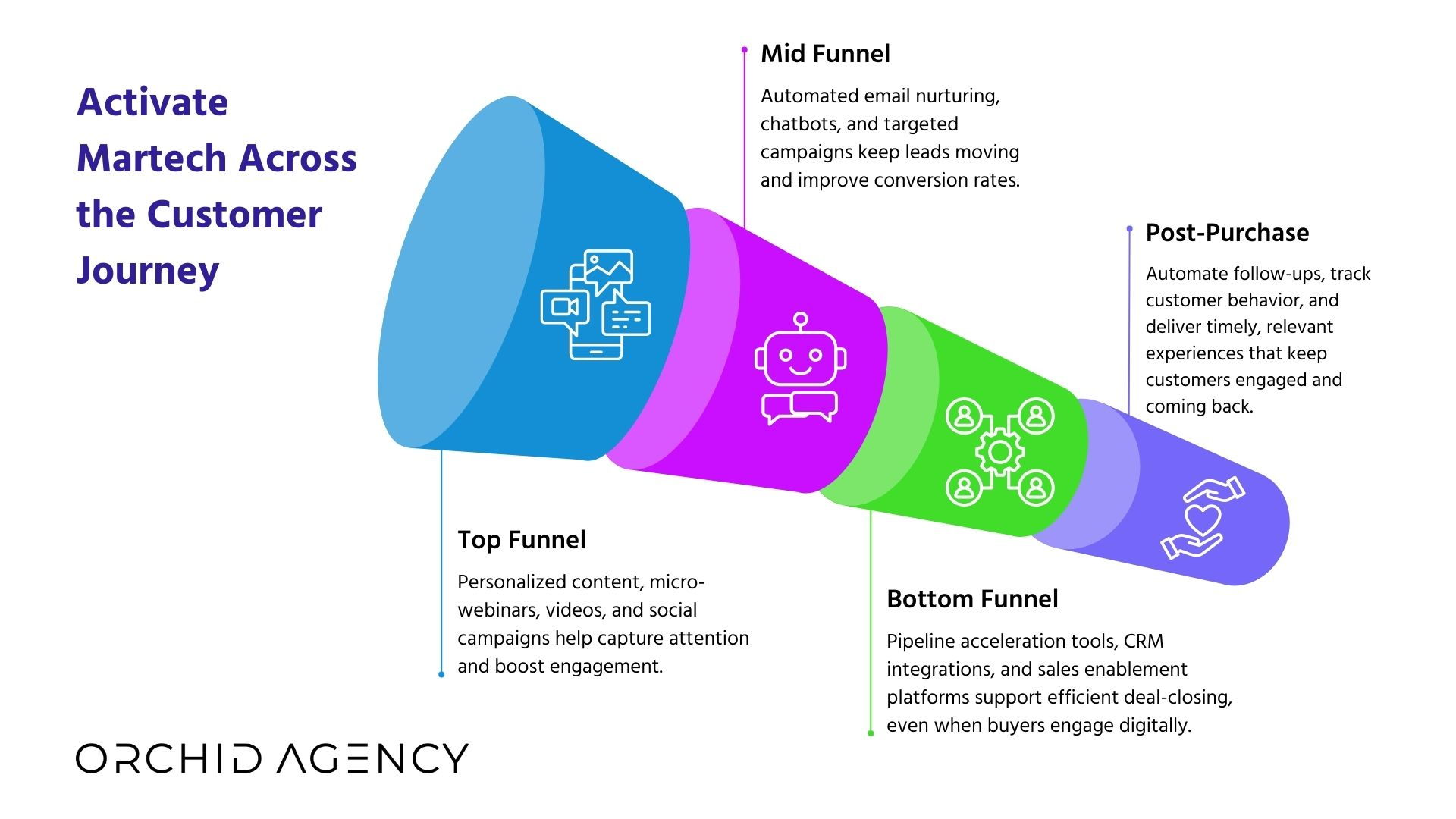
When each stage is supported intentionally, startups gain consistency, predictability, and scale.
Measure What Actually Drives Revenue
Martech ROI often breaks down because measurement is misaligned. Clicks and opens may look encouraging, but they rarely show whether marketing is actually driving revenue. High-performing startups focus instead on impact metrics tied to real business growth.
Those metrics include:
- Pipeline contribution: This measures how much qualified pipeline marketing generates or influences. It connects campaigns and tools directly to revenue potential, making it clear which efforts are actually feeding the sales engine.
- Conversion rates across stages: Tracking how prospects move from one stage to the next reveals where momentum builds or stalls. Improvements here signal that martech is not just attracting attention, but guiding buyers toward purchase.
- Customer acquisition cost (CAC): CAC shows how efficiently growth is being achieved. Martech should help lower acquisition costs over time by improving targeting, nurturing, and automation, not inflate them.
- Customer lifetime value (LTV): LTV captures the long-term value of a customer relationship. Martech delivers its strongest returns when it supports retention, upsell, and deeper engagement beyond the initial sale.
- Retention and expansion revenue: This is where martech’s impact compounds. Up to 70% of future revenue often comes from existing customers, making retention and expansion critical indicators of whether technology is supporting sustainable growth.
When martech is evaluated against these metrics, ROI becomes visible and actionable. Tools are no longer judged by activity alone, but by how effectively they drive revenue today and growth over time.
Operationalize for Continuous ROI Improvement
Martech ROI isn’t a one-time win. It’s an operating discipline that improves as systems, people, and processes evolve.
Focus on a few core practices:
- Run regular stack audits: Identify overlap, underused tools, and consolidation opportunities. High-performing teams target about 61% utilization within a year, ensuring tools are used, not just purchased.
- Invest in training and enablement: Marketing teams that are fully empowered are 7× more likely to exceed growth expectations, making training one of the highest-return investments.
- Establish clear governance: Ensure every new tool aligns with defined business outcomes and that spending remains accountable.
- Experiment deliberately: Test AI, micro-webinars, and automation through small, measurable pilots before scaling.
Together, these practices turn martech from a static expense into a system that compounds value over time.
It’s Strategy
Today, organizations use, on average, 49% of their martech stack’s capabilities, up from 33% in 2023. That’s progress, but it still leaves a lot of untapped value, even as planned utilization is expected to reach 61% over the next year.
The startups that win don’t chase technology for its own sake. They align tools to outcomes, integrate data across teams, and focus on what truly drives revenue.


