
6 Ways to Boost ROI with Customer-First Content


Modern buyers now expect brands to understand their needs, anticipate challenges, and deliver content that feels tailored rather than generic. Yet despite increased investment, most personalization efforts fall flat.
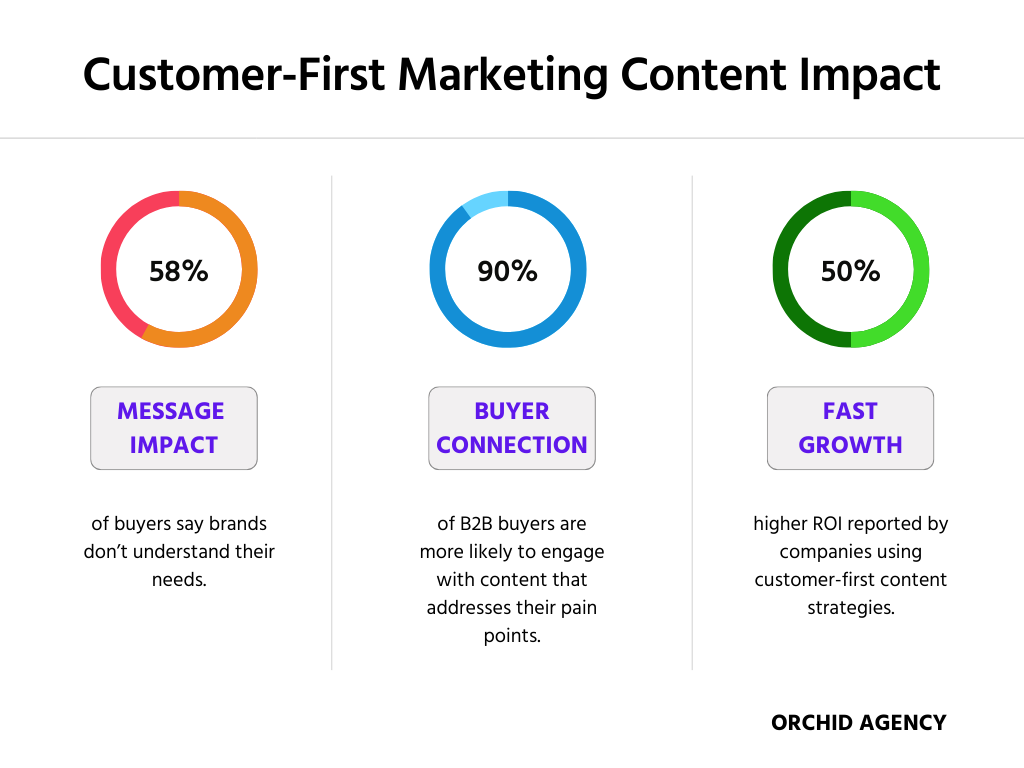
Gartner’s latest research shows the heart of the issue: 58% of buyers say brands don’t understand their needs.
In this blog, we’ll break down what customer-first content really means, explore why personalization often falls short, and show how to turn real buyer insights into measurable ROI.
What is Customer-First Content?
Customer-first content is built around what your audience actually cares about. Its content based on real conversations and feedback, not assumptions.
Customer-first content uses inputs like:
- Buyer interviews
- Sales calls
- Product usage data
- Support tickets
- Win/loss insights
- Self-reported interests
Customer-first content is created by translating these insights into relevant messaging, topics, and formats that speak to your customers' exact challenges.
What’s more is that 83% of B2B buyers say personalization makes their experience with a vendor better.
Why Customer-First Personalization Drives Real Revenue Impact
Gartner found that buyers who receive personalized interactions are:
- 3.7× more likely to purchase more than originally planned
- 1.8× more likely to increase their deal size
- 1.3× more likely to become repeat buyers
This matters because, as you know, B2B buying cycles are long and complex. One misaligned message can slow momentum; alternatively, one moment of clarity can accelerate it.
But this type of outreach comes with a catch. Buyers are increasingly protective of their data. And who can blame them? From 2021 to 2024, the number of consumers willing to give up personalization rather than be tracked grew by seven points.
This means that your personalization strategy must be built on trust, transparency, and actual insight.
Here’s a deeper look at the B2B buyer’s journey.
How To Truly Connect with Buyers
Many B2B teams struggle because their content doesn’t truly reflect what buyers need. Here’s how to bridge that gap and make your content resonate:
1. Use the data that buyers prefer
Instead of relying on inferred behavioral data, prioritize the signals buyers willingly share, like past activities, self-identified needs, and communication preferences. This better aligns with buyers’ rising expectations for transparency.
2. Personalize across the journey, not just top-of-funnel
B2B buyers want information that matches the different stages of their buying journey. Companies seeing the greatest gains personalize not just emails or ads, but all content along the journey.
3. Be transparent about data usage
B2B buyers face internal compliance pressure. Explaining why you collect data and how it improves their experience builds trust and boosts engagement.
Here’s a useful article to help you stay compliant regarding data privacy.
4. Use customer insight as your personalization engine
This is the biggest lever. Buyer interviews, win/loss insights, customer onboarding feedback, and usage data create the kind of understanding that enables personalization to feel human.
Real Ways to Boost ROI With Customer-First Content
1. Turn customer language into messaging that resonates
Nobody wants to listen to corporate jargon or buzzwords. Your messaging should use the same words your customers do. Listen to sales calls, interviews, and support conversations, then pull the phrasing directly into your social posts, newsletter, and ads. This makes your message instantly clearer to buyers.
2. Build content around real challenges
This one is really simple- check your content with two questions:
– Does this solve an actual customer problem?
– Does it help them justify or explain a decision?
If the answer is no to one or both of these questions it’s time for a refresh. Content aligned to real pain points performs better across every channel.
3. Choose formats that are easy to digest
Most prospective buyers are not interested in reading long-form content, frankly because they don’t have time. Use formats that make information fast, visual, and easy to digest. Short videos help buyers grasp concepts in seconds. ROI-driven case studies show impact without fluff. Interactive calculators and comparison pages help buyers evaluate solutions on their own.
When your content reduces effort, buyers move through the journey faster.
4. Use customer insight at every stage of the funnel
- Top of funnel: Thought leadership rooted in real customer problems
- Mid-funnel: Objection handling, case studies, proof points
- Bottom of funnel: Implementation guidance, ROI proof, decision enablers
Each stage becomes stronger when it reflects what buyers truly care about.
5. Lead with real customer stories
Customer stories will outperform sales copy any day. Buyers put a lot of trust in recommendations and reviews. When creating testimonials, make sure to highlight specific outcomes, workflows, metrics, and before-and-after moments. Show screenshots, quotes, timelines, and resolved pain points. Pull in perspectives from different stakeholders to reflect all the decision makers.
The more real and specific the story, the more confidently future buyers can picture themselves succeeding.
Here’s more on building communities.
6. Turn support insights into friction-removing content
Identify the questions support teams hear most. You can turn them into help articles, walkthrough videos, self-serve tools, and nurture emails. Reducing friction speeds up decisions and boosts retention.
Wrapping Up
The bottom line is that buyers want to be met where they are in the buying journey with content that resonates, provides solutions to problems, and feels trustworthy.
If you do this well your business stands out from the competition and your revenue grows quickly.


