
5 Strategic Moves B2B Marketers Can Make to Drive Higher ROI


B2B marketers are operating in a far less forgiving environment. Buying cycles are longer, budgets are scrutinized line by line, and your stakeholders expect you to show a clear path from spend to revenue. ROI is no longer a post-campaign calculation; it’s a strategic expectation.
The difference between marketing teams that struggle to justify their value and those that consistently outperform comes down to strategic positioning, alignment, and measurement. The evidence is strong: organizations where CMOs are significantly involved in growth strategy are 7x more likely to exceed executive expectations.
Why Marketing ROI is Under More Scrutiny Than Ever
Marketing budgets are tight, buying journeys are harder to influence, and more stakeholders are asking, “What did we get back for what we spent?” Gartner’s 2025 CMO Spend Survey reported that budgets have essentially flatlined at 7.7% of company revenue. When budgets are tightened, marketing efforts that can’t prove business impact are the first to be questioned.
Meanwhile, buyers are doing more without you:
- 80–90% of B2B buyers research online before engaging with a sales team.
- Buyers complete 50–70% of their decision-making journey before the first sales conversation.
So ROI doesn’t come from “more activity.” It comes from a tighter strategy, tighter alignment, and tighter measurement.
1. Make Marketing a Driver of Business Strategy
Marketing performs dramatically better when it’s treated as a growth function, not a service desk.
Organizations where CMOs are significantly involved in growth strategy are 7x more likely to exceed executive expectations (Gartner).
Here’s what “seat at the table” needs to look like in practice:
Turn Corporate Goals into Revenue Drivers
Stakeholders invest in marketing to drive business results. So if your company’s goal is to grow enterprise revenue, marketing needs to clearly show who it’s targeting, what will influence them, how they’ll be reached, and how much revenue and pipeline those efforts are expected to generate.
Own the “How We Win” Story
When leadership debates growth, marketing should be the function that brings customer truth: what buyers care about, what they compare, why deals stall, and what proof closes the gap. This is how marketing becomes strategy, not slides.
2. Align Marketing and Sales Around Shared Goals
Sales isn’t just a partner. Sales is marketing’s #1 internal stakeholder, because pipeline is the shared scoreboard.
And the ROI upside is real:
- B2B companies with strong sales and marketing alignment see 20–30% higher revenue growth.
- Poor alignment between sales and marketing costs organizations millions of dollars annually in lost revenue and efficiency.
What Alignment Actually Means (Beyond “Weekly Meetings”)
Alignment is operational. It is reflected in shared definitions, shared priorities, and shared accountability.
Use a simple, high-ROI structure:
- Shared ICP + buying triggers: Sales and marketing agree who matters and why now.
- One funnel language: MQLs don’t matter if sales don’t trust them. Define the stages both teams use.
- SLA-driven workflow: Who follows up, how fast, what “good” looks like, what happens when leads aren’t ready.
- Closed-loop feedback: Marketing learns what converts, not what clicks.
Align Channels to Revenue Outcomes (not Internal Opinions)
The fastest way to burn budget is to spread effort across too many channels “just in case.” The better move is to prioritize channels that match your buyer’s behavior and your team’s ability to execute consistently.
This is especially true for growth-stage teams. We recommend prioritizing a small set of channels you can execute well, validate performance, then scale what’s working, instead of fragmenting spend across everything at once.
Here’s a deeper look into prioritizing the right channels for your business.
3. Focus on Metrics That Matter
If you want a stronger ROI, you need stronger proof, and that means moving past vanity metrics like impressions, clicks, or traffic.
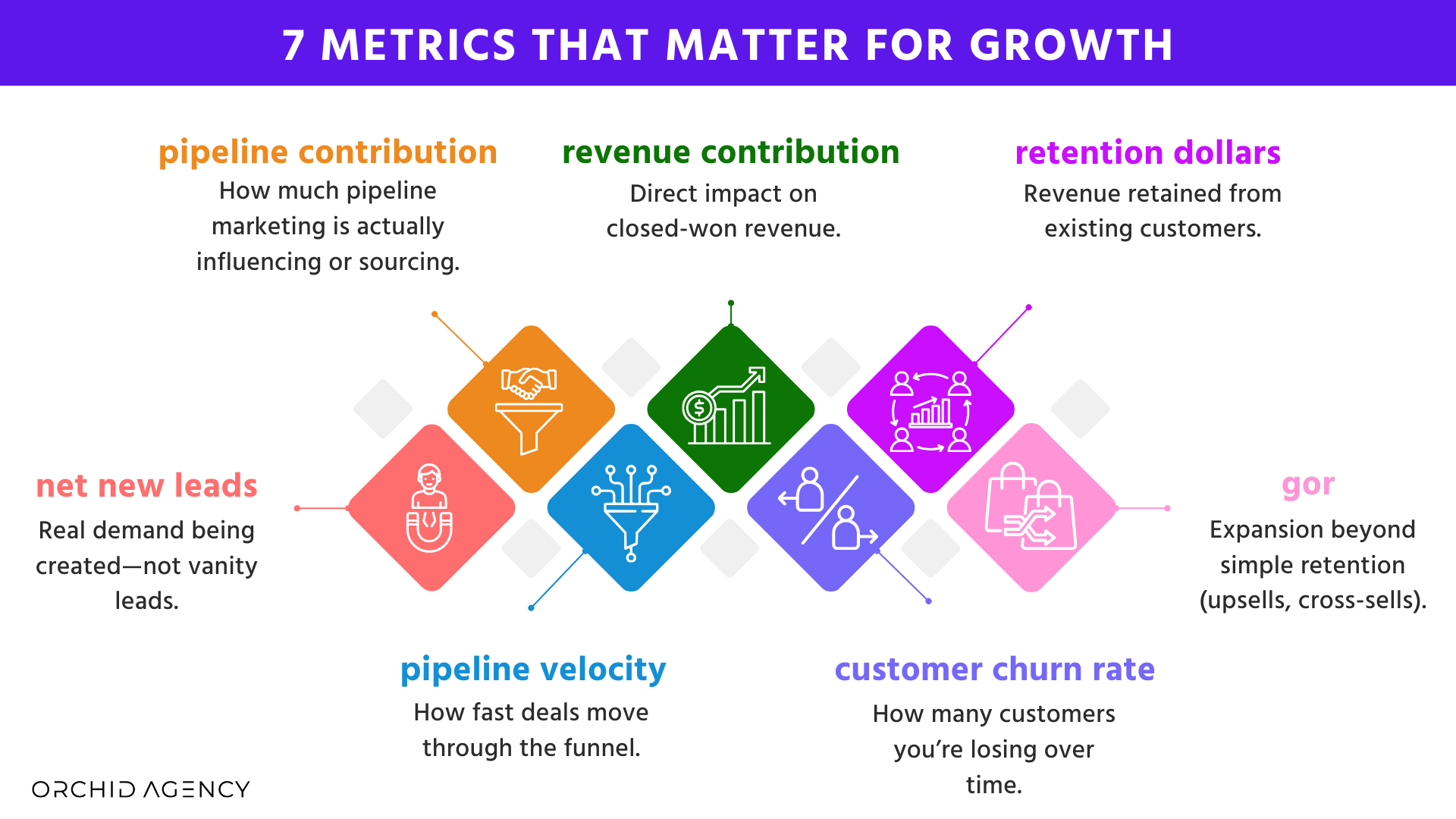
Two ROI truths matter here:
- Improving pipeline velocity can accelerate revenue without increasing lead volume.
- Marketing teams that tie performance to pipeline and revenue are more likely to retain or increase budget year over year.
A Clean Way to Report Metrics
Use a “Revenue Narrative” format in every monthly/quarterly update:
- What we built (campaigns, plays, programs)
- What it produced (qualified leads, meetings, opps created)
- What it influenced (pipeline $, velocity lift, win-rate contribution)
- What we’re doing next (one bet to scale, one bet to stop)
Here’s the ultimate list of metrics that matter for marketing.
4. Build Systems That Support Scalable Growth
Gartner data highlights how often marketing strategy breaks down internally: 84% of CMOs report high levels of strategic dysfunction, and organizations with high dysfunction were 36% less likely to report strong business and marketing performance.
That dysfunction shows up as:
- Unclear priorities
- Too many campaigns
- Too many stakeholders
- No consistent operating rhythm.
The Systems That Unlock ROI (Without Adding Headcount)
Build a lightweight operating model:
- Quarterly growth plan: ICP, offers, channel focus, revenue targets.
- Campaign pods: marketing + sales + enablement + RevOps per segment or product line.
- Single source of truth: dashboards tied to pipeline and revenue.
- Content mapped to the buyer journey: because buyers are self-educating first.
If your systems don’t support that self-education (clear positioning, proof, use cases, comparisons, outcomes), sales will meet buyers too late, and your ROI will always look “soft.”
5. Prove Marketing’s Impact Consistently
ROI doesn’t only need to exist; it needs to be understood.
The most effective CMOs reduce executive uncertainty by making marketing performance legible:
- What marketing owns
- What sales owns
- What’s shared
- What’s happening in the pipeline because of it
A strong cadence looks like:
- Weekly: pipeline creation + velocity indicators (short update)
- Monthly: pipeline contribution, revenue influence, channel efficiency
- Quarterly: strategy review + budget reallocation (double down / cut / test)
This is also where you protect budget: when finance sees a clear line from spend → pipeline → revenue, marketing stops being treated like a cost center.
Final Takeaway: ROI Follows a Strategic Clarity
Higher marketing ROI doesn’t come from doing more, it comes from doing what matters.
When marketing has a seat at the strategy table, aligns tightly with sales, focuses on revenue-linked metrics, and builds scalable systems, ROI becomes a byproduct of good decisions rather than a defensive calculation.
The organizations winning today aren’t asking whether marketing is working. They’ve structured marketing so that it has to.


