
Startup ABM: How to Target Big Accounts Without A Big Budget


Most early-stage startups assume Account-Based Marketing (ABM) is something only large companies can afford to do well. It is often associated with expensive tools, big teams, and complex systems that feel out of reach. But that’s not what makes ABM effective.
What actually drives results is focus. Startups already have an advantage here. You are closer to your customers, faster to act, and more intentional with how you spend time and money.
Instead of chasing volume, ABM helps you zero in on the accounts that matter most. The ones that are most likely to convert, stay longer, and generate meaningful revenue.
And the results speak for themselves. ABM delivers the highest ROI of any B2B marketing strategy (ITSMA) and 87% of marketers say ABM outperforms other marketing initiatives.
What ABM Looks Like for Startups
At its simplest, ABM is a strategy where you identify specific companies you want to win, then tailor your outreach and messaging directly to them.
For startups, this means moving away from volume and leaning into precision. Instead of generating hundreds of leads, you focus on a smaller group of high-fit accounts and engage them in a more thoughtful way.
This approach works naturally for lean teams. You do not have the bandwidth to waste time on unqualified leads, so every interaction needs to count.
It also means you do not need a complicated tech stack to succeed.
Many startup teams run effective ABM programs using tools they already have:
- LinkedIn for research and outreach
- Shared spreadsheets to track and prioritize accounts
- A simple CRM to stay organized
The goal is simple. Less noise. More intention.
Why It Works Now
The way B2B buyers make decisions has changed, and ABM aligns with that shift.
Buying decisions are now made by groups, not individuals. The average B2B buying group includes 6–10 decision-makers. Each person has different priorities, which means generic messaging rarely works.
At the same time, buyers are harder to reach. Buyers spend only 17% of their time meeting with vendors (Gartner) and 70%+ of the buyer’s journey happens before sales engagement. By the time you get their attention, they are already informed.
This is where personalization becomes critical. 80% of B2B buyers expect personalized experiences, and personalized campaigns can drive 20%+ higher engagement rates.
ABM meets buyers where they are. It delivers relevant messaging to the right stakeholders at the right time. That is why it continues to outperform broader approaches.
Core ABM Approach (Simplified)
A strong ABM strategy doesn’t need to be complicated to be effective. For startups, the goal is to build a simple process that helps you focus on the right accounts and engage them with more intention.
Here are the core steps that can help you turn that focus into a more practical and repeatable strategy:
1. Define Your Ideal Customer Profile (ICP)
Start by getting clear on who you want to work with. Look at industry, company size, revenue, and common challenges your solution solves.
A strong ICP keeps your efforts focused and prevents wasted time.
2. Build a Target Account List
Once your ICP is clear, create a list of companies that match it. Keep it focused and realistic.
You do not need hundreds of accounts to see results. In fact, fewer, high-value accounts tend to outperform broad targeting in ABM programs.
3. Research Each Account
Take time to understand each company. Look at recent updates, leadership changes, hiring trends, and current initiatives.
This context allows you to speak directly to what matters to them.
4. Deliver Personalized Outreach
Your outreach should feel intentional, not automated. Reference real insights about the company and tailor your message to their situation.
Relevance is what gets replies.
5. Align Sales and Marketing
ABM works best when sales and marketing operate as one team. Shared goals and consistent messaging create a better experience for the buyer.
When teams are aligned, the impact is measurable. Companies with strong sales + marketing alignment see 20%+ higher revenue growth.
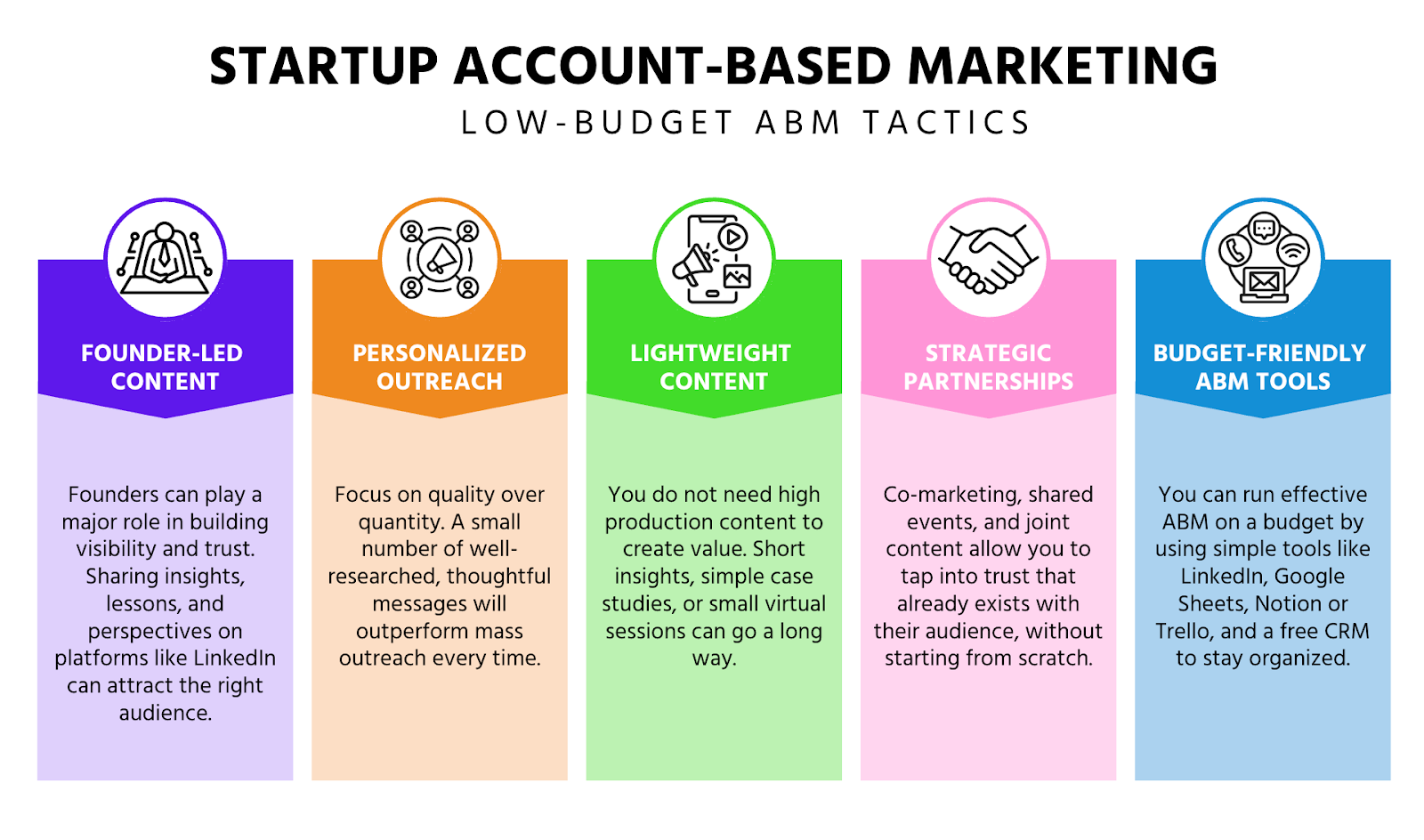
Low-Budget ABM Tactics
You do not need a large budget to run effective ABM, especially as an early-stage startup. What you do need is creativity, consistency, and a clear sense of where to focus your efforts.
1. Founder-Led Content
Founders can play a major role in building visibility and trust. Sharing insights, lessons, and perspectives on platforms like LinkedIn can attract the right audience.
This matters because 75% of B2B buyers use social media to inform purchasing decisions.
2. Personalized Outreach
Focus on quality over quantity. A small number of well-researched, thoughtful messages will outperform mass outreach every time.
3. Lightweight Content
You do not need high production content to create value. Short insights, simple case studies, or small virtual sessions can go a long way.
This approach is efficient and effective. Content marketing generates 3x more leads than outbound and costs 62% less.
4. Strategic Partnerships
Partnering with complementary businesses can help you access new audiences faster and build credibility by association. Co-marketing, shared events, and joint content allow you to tap into trust that already exists with their audience, without starting from scratch.
Referrals play a big role in B2B decisions. 84% of buyers start with a referral in the purchase process.
5. Budget-Friendly ABM Tools
You can build a strong ABM foundation with simple tools:
- LinkedIn for research and outreach
- Google Sheets for tracking accounts
- Notion or Trello for collaboration
- Free CRM tools like HubSpot
- Email platforms like Gmail or Outlook
Tools support the process, but they are not the strategy.
Common Pitfalls That Can Derail Startup ABM
Even a strong ABM strategy can lose momentum when a few key mistakes show up. For startups, these missteps can quickly slow growth. The challenge is not a lack of tools or budget. It is usually a lack of focus or clarity.
- Going Too Broad: Trying to target too many accounts weakens your efforts. ABM works because it is focused. Expanding too quickly makes your messaging less relevant and less effective.
- Over-Automating: Automation can help with efficiency, but too much of it removes the human element. ABM depends on personalization, and that cannot be fully automated.
- Prioritizing Tools Over Strategy: It is easy to believe the right software will solve everything. In reality, tools only amplify your strategy. Without clear targeting and strong messaging, they do very little.
Bottom Line: Start Small, Target Smart
Startups do not need bigger budgets to win larger accounts. They need better focus.
ABM gives you a clear path to do that. It helps you concentrate on the accounts that matter, deliver more relevant messaging, and build stronger relationships from the start.
When done well, it aligns perfectly with how buyers make decisions today. Buyers expect relevance, personalization, and value at every step.
In a crowded market, attention is limited. The teams that win are the ones that use it wisely.


