
5 Reasons Your Marketing Strategy Isn't Driving Pipeline


We've worked with many startups over the years, and one of the most common challenges we see is a disconnect between marketing activity and pipeline performance. Teams are publishing content, driving website traffic, and launching campaigns, but revenue growth isn't keeping up.
The reality is that generating awareness is only one piece of a startup marketing strategy. To drive consistent growth, marketing efforts should be aligned with business objectives, target audiences, and conversion goals. Without that alignment, even the smartest marketing efforts can struggle to generate steady revenue.
Why Are My Marketing Efforts Not Translating into Pipeline Growth?
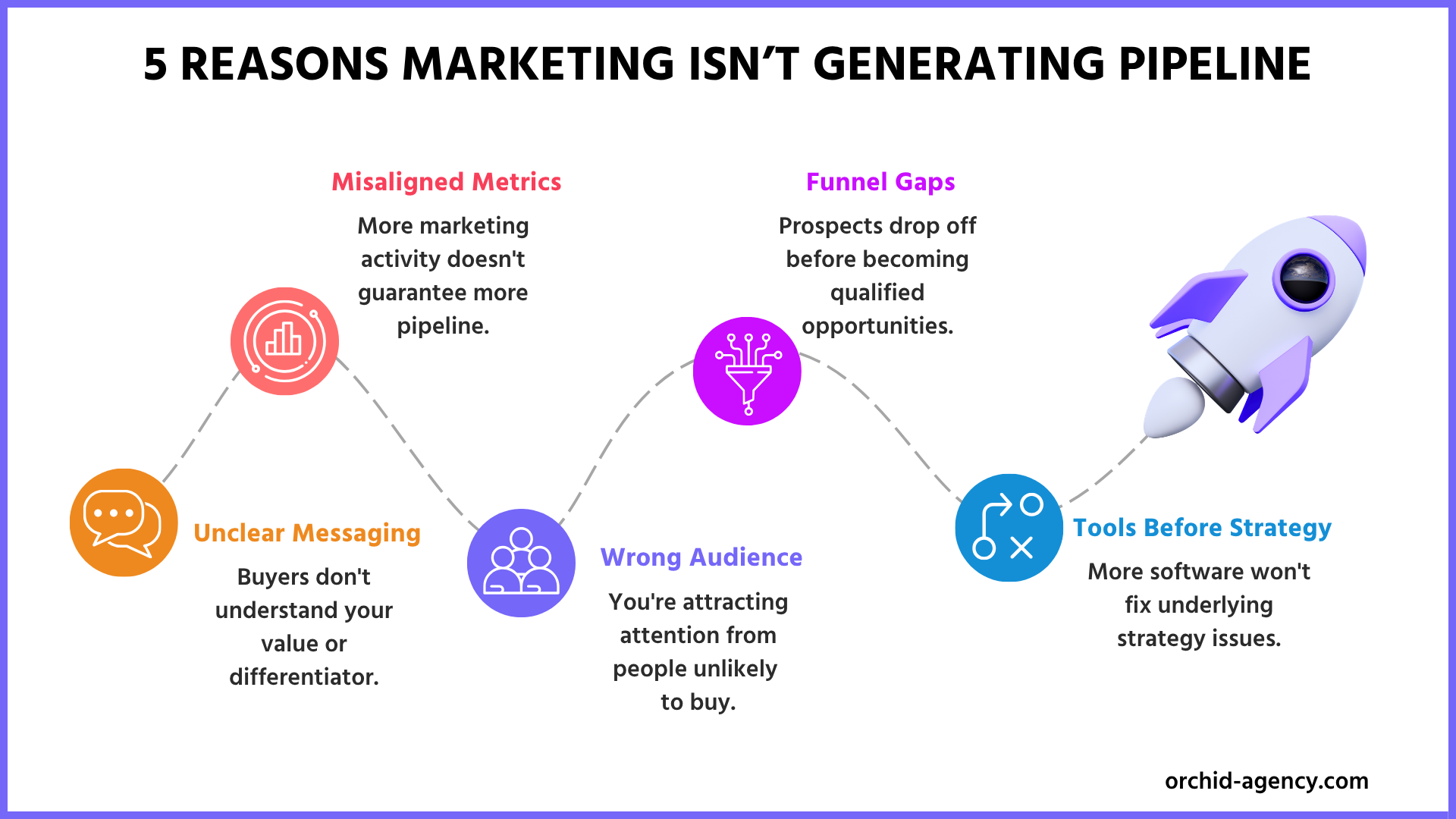
1. Your Positioning and Messaging is Unclear
Before prospects book a demo, download a resource, or engage with your content, they need to understand what your company does and your differentiator.
You’ve got to put your customer first when it comes to messaging. We see lots of startups struggling with messaging that is too broad, overly technical, or focused on features rather than customer outcomes. As a result, buyers may not quickly recognize your value prop.
According to HubSpot, 42% of marketers say standing out in a saturated market is one of their biggest challenges.
Strong messaging should clearly answer these questions:
- Who do you help?
- What problem do you solve?
- How is your solution different?
- What outcomes can customers expect?
When positioning is clear, marketing becomes more effective across every channel.
2. You're Focusing on Activity Instead of Outcomes
Marketing teams today have access to more channels, tools, and tactics than ever before. While these resources create new opportunities, they can also make it easy to prioritize activity over impact. And the truth is, more campaigns do not automatically lead to pipeline growth.
Instead, every marketing initiative should support a larger business objective.
According to Gartner's 2025 CMO Spend Survey, digital channels now account for more than 60% of total marketing spend. Despite these investments, many organizations continue to struggle with demonstrating measurable business impact.
Instead of asking, "What should we create next?" consider asking, "How does this contribute to pipeline and revenue goals?"
Example: You might generate 200 webinar registrations and consider your webinar a success. But only a handful of attendees might fit the ideal customer profile, with no opportunities created. Success should be measured by business outcomes, not participation metrics alone.
This brings us to our next point!
3. You're Attracting the Wrong Audience
Traffic and lead volume can be good indicators of performance, but they do not always tell the full story.
Many startups generate engagement from audiences that are unlikely to become customers. This can create the appearance of marketing success with no impact on your pipeline.
Signs this may be happening include:
- High website traffic with low conversion rates
- Strong content engagement, but few qualified opportunities
- Growing lead volume without corresponding revenue growth
According to Gartner, B2B buying groups typically involve 6 to 10 decision-makers, each bringing different priorities and perspectives to the purchasing process. If your messaging and targeting aren't aligned with the right audience, generating traffic and engagement won't necessarily translate into a qualified pipeline.
4. Your Funnel Is Creating Friction
Generating interest is only the first step in the buyer journey.
Once prospects engage with your brand, they should be able to move smoothly through the funnel toward a conversion action. Unfortunately, many startups invest heavily in lead generation while overlooking opportunities to improve the customer experience after the click.
Common challenges include:
- Unclear calls-to-action
- Confusing landing page experiences
- Slow lead response times
- Poor lead qualification processes
- Misalignment between marketing and sales
According to Econsultancy, only 22% of businesses are satisfied with their conversion rates.
Often, improving pipeline performance does not require more traffic. It requires reducing barriers that prevent prospects from taking the next step.
Here’s more on fixing a leaky marketing funnel.
5. You're Relying on Tools Instead of Strategy
Marketing technology plays an important role in supporting growth. However, technology alone cannot solve strategic challenges.
We see many startups investing in new platforms, automation tools, and AI solutions. While these investments can increase efficiency, they are most effective when built on a strong strategic foundation.
Focus on positioning: If positioning is unclear, targeting is misaligned, or conversion paths are weak, additional software is unlikely to solve the underlying issue.
The most successful startups establish clear goals, understand their audience, and build repeatable marketing processes before expanding their technology stack.
Here’s a bonus blog on the marketing efforts you should focus on vs. a collection of tools.
Turning Marketing Activity Into Pipeline
If your marketing efforts are generating attention but not revenue opportunities, it may be time to evaluate the fundamentals.
Start by asking:
- Is your messaging clear and differentiated?
- Are you reaching the right audience?
- Are your marketing activities aligned with business objectives?
- Are prospects moving efficiently through our funnel?
- Is your technology supporting our strategy?
Answering these questions can help identify opportunities to improve performance and create a stronger connection between marketing efforts and pipeline growth.
Let’s chat about building a marketing strategy that drives measurable business results.


